Written by Promise Phelon, GWC’s founder and managing director
——
How Shifting from “Technology Sales” to “Organizational Staffing” Accelerates AI Adoption
Most founders and investors likely know Geoffrey Moore's "Crossing the Chasm"—the chasm being the gap between early adopters who buy on vision and the pragmatic majority who buy on proof. But after decades as an operator and now as an investor in enterprise and industrial AI, I've come to believe we've been misdiagnosing why so many AI companies die in the chasm.
It's not a trust gap. It's a diligence gap.
The Real Divide, The Looming Chasm
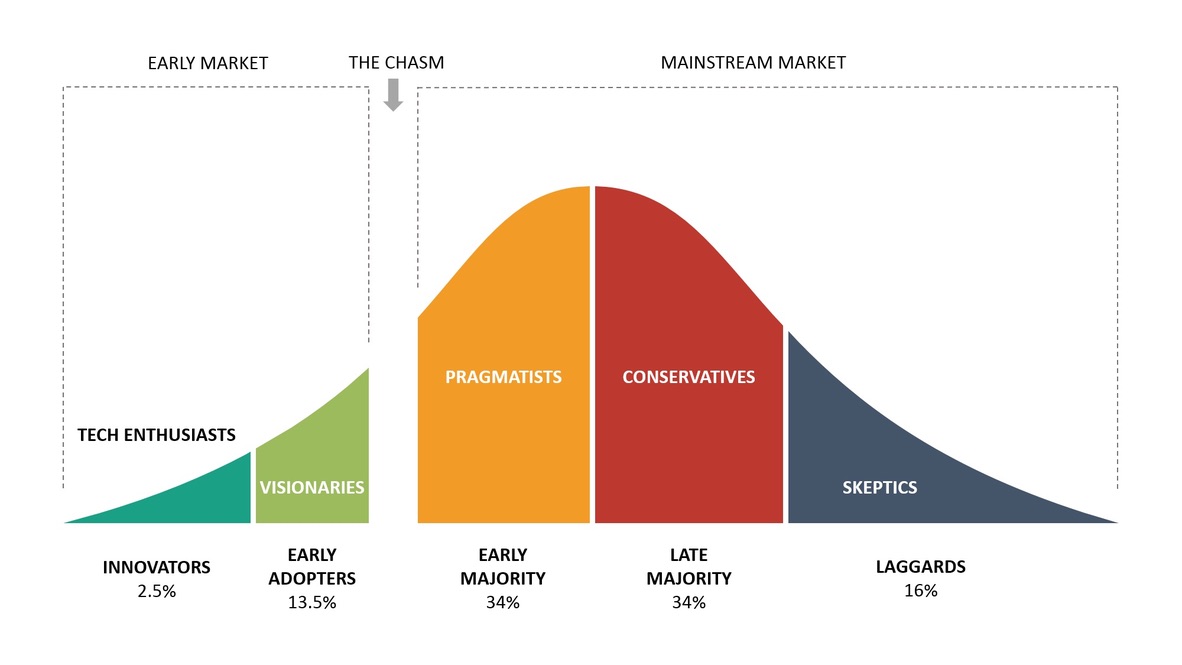
On the left side of the chasm, you have tech enthusiasts and visionaries—about 16% of the market. These buyers can evaluate technology. They run bake-offs, compare inference speeds and debate fine-tuning approaches. They have internal teams who speak the language. They've done this before.
On the right side? The pragmatists and conservatives—68% of the market. They're not less intelligent or resistant to change. They simply have no muscle for evaluating AI. They've never done it. They don't have the vocabulary, the frameworks or the internal teams.
So what do they do? They build underwhelming homegrown solutions. They hire consultants who overpromise. They pilot something, watch it stall and quietly shelve it. Or they do nothing and hope the problem solves itself.
Too many AI startups mistake the early market for the whole market. They over-optimize for technical buyers—the CTO who wants to see the architecture diagram, the ML engineer who wants to debate model selection. Then they wonder why they can't break out of a $10M ARR ceiling. The answer is simple: They built a go-to-market for 16% of the market and called it a strategy.
The 100,000-Hour Advantage
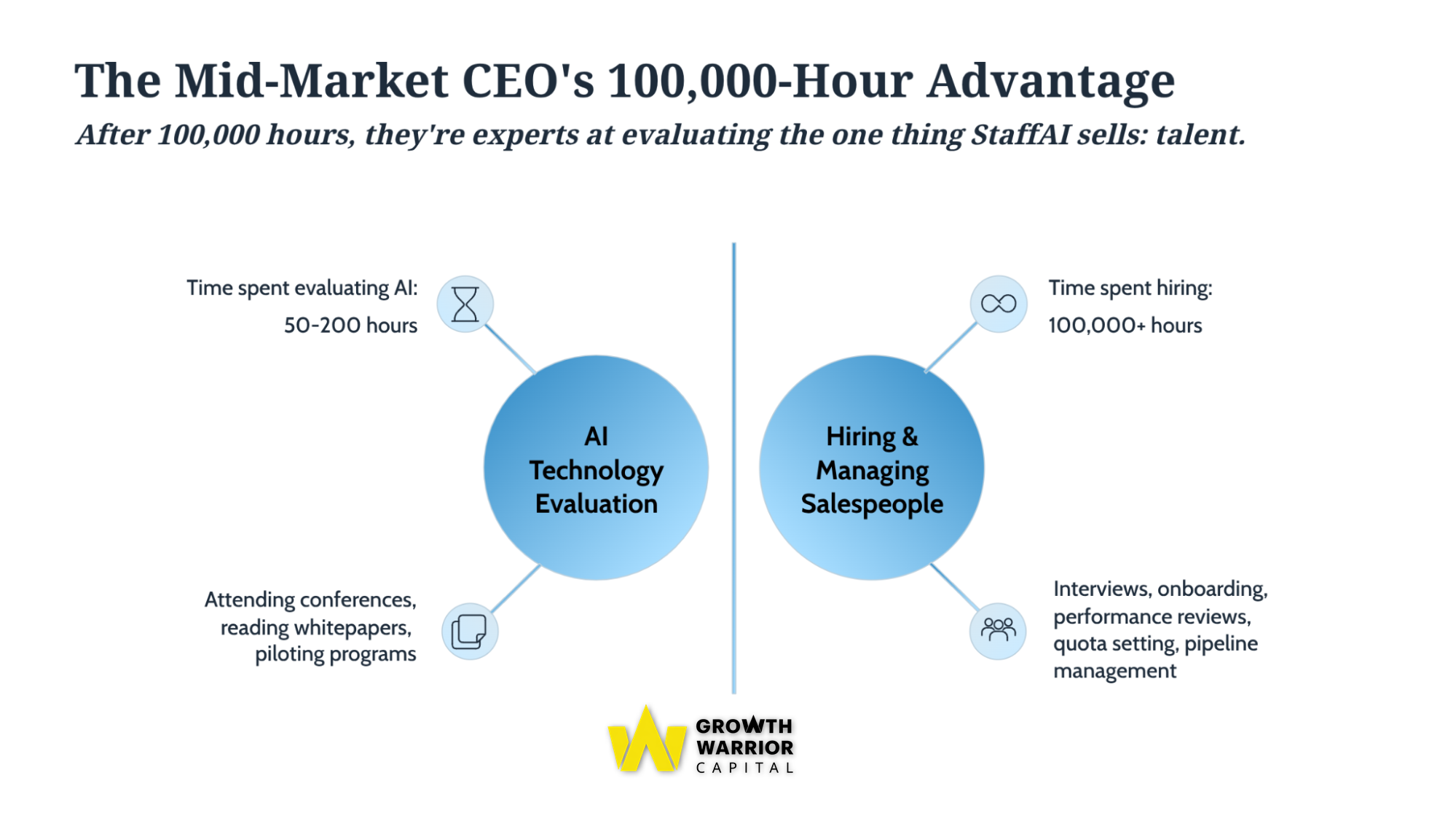
Here's one thing those same pragmatist customers can do: Hire and assess talent.
A regional HVAC distributor may not know how to evaluate RAG architecture. But they've hired hundreds of salespeople over decades. They know what a good one looks like in the first five minutes of an interview. They know how to onboard them, set quotas and hold them accountable. They've developed instincts about who will produce and who will wash out.
And it’s not a skill they learned from a book. It's pattern recognition built over 100,000 hours of reps. It's the thing they're best at.
The question for AI companies becomes: Can you present your technology in a form factor that lets customers use skills they already have?
What "AI as Talent" Actually Looks Like
This is the insight behind our decision to lead the Seed round in the AI staffing innovator StaffAI, and it's worth unpacking because the difference is structural, not just semantic.
Traditional AI sales motion:
- Sell to technical buyer or innovation team… friction, friction, friction….
- Run a proof-of-concept or pilot, or get caught in a bake-off with comparables and unrelated vendors.
- Negotiate an enterprise contract.
- Implement and integrate over months.
- Measure adoption metrics.
- Pray for renewal.
StaffAI's motion:
- Customer "hires" an AI sales rep; the hiring manager literally signs an independent contractor agreement with the AI employee vs. a software services agreement, bypassing IT procurement.
- AI signs a 1099.
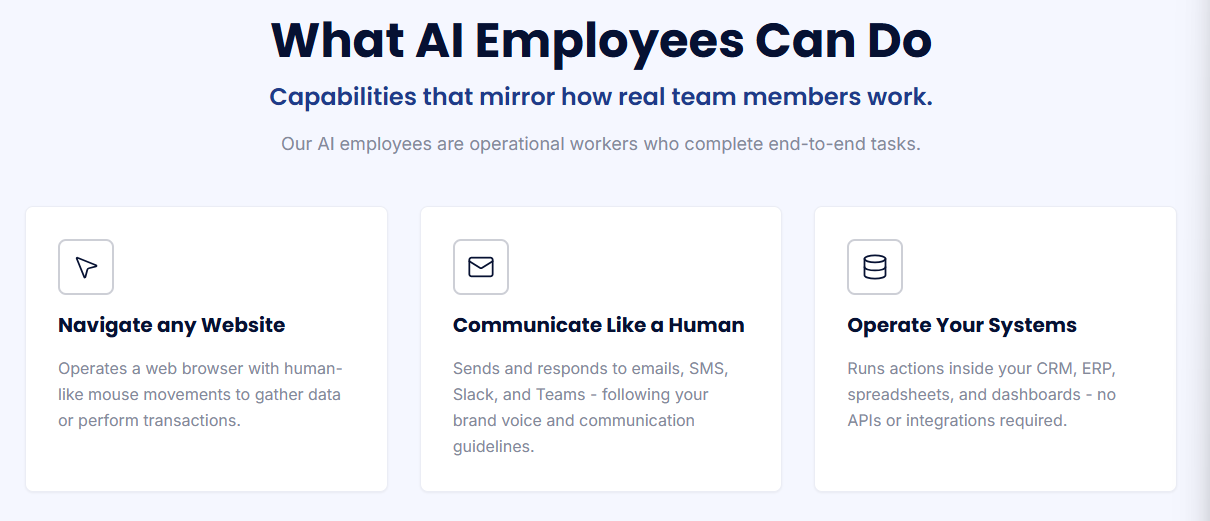
- AI onboards into existing systems (CRM, email, phone); the AI employee taps StaffAI’s “computer use” to navigate the desktop, no API integration required.
- AI starts working immediately on commission, using the same commission structure the company has established for its existing sales/marketing team.
- Customer measures quota attainment.
- Customer hires more AI reps as revenue accumulates.
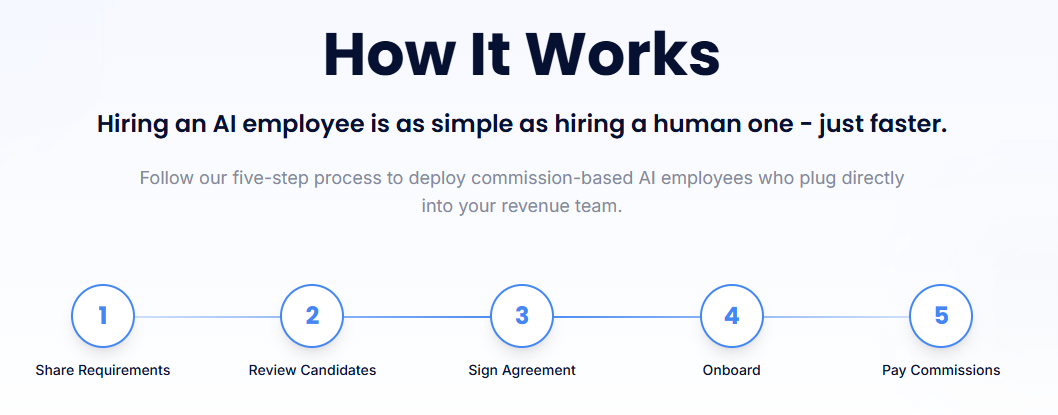
The customer never evaluates "the platform." They evaluate the employee. They don't “implement software.” They “onboard a new hire.” They don't “negotiate seat licenses.” They “set commission structures.” They don't track “adoption dashboards.” They track “pipeline generated.”
Every touchpoint maps to something the customer has done thousands of times. The cognitive load for using the platform drops to near zero.
Why Commission-Only Changes Everything
The commission-only model deserves its own discussion because it inverts the risk equation entirely.
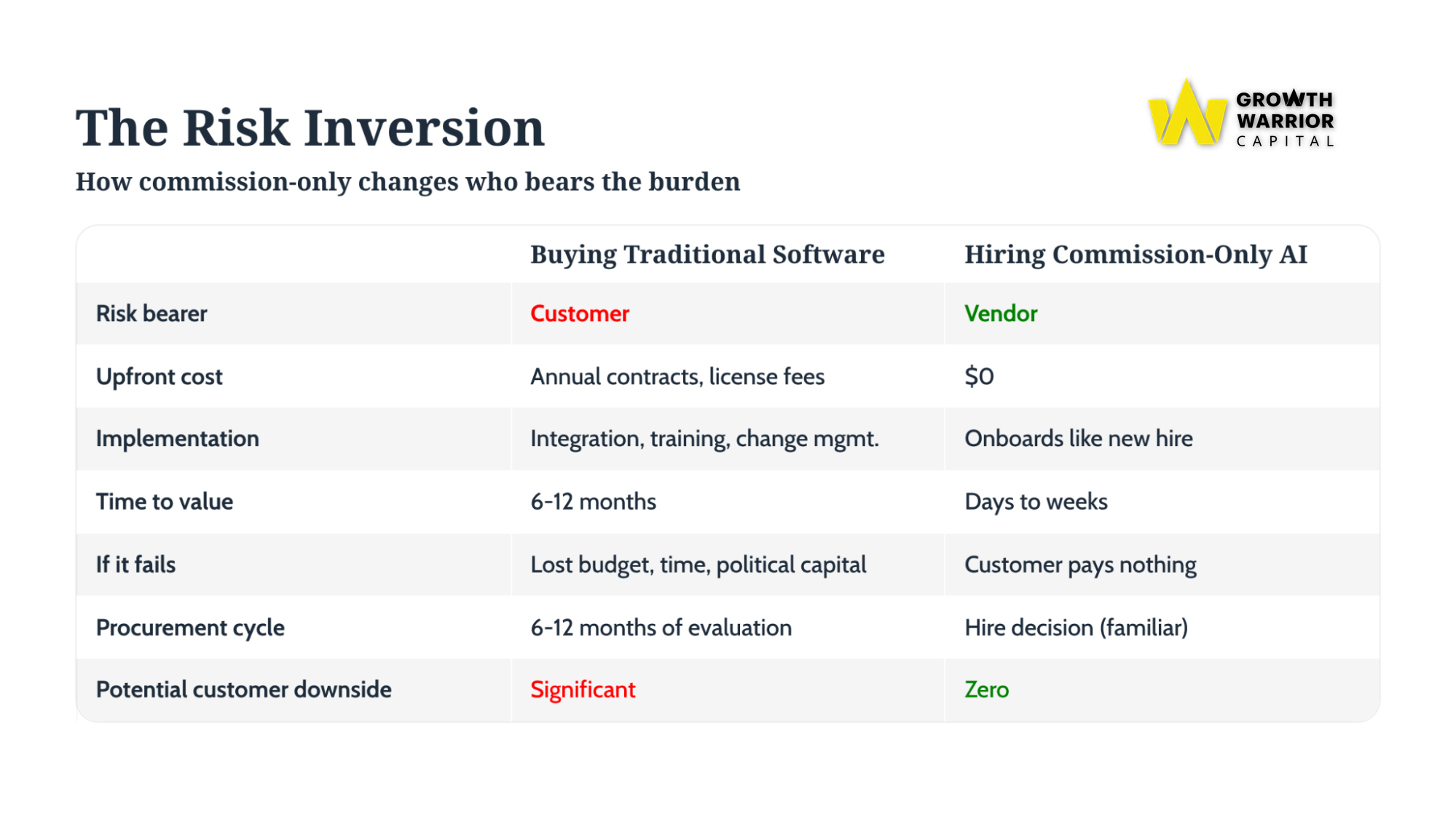
In traditional enterprise software, the customer bears all the implementation risk. They pay upfront (or commit to annual contracts), invest in integration and training their teams and hope the ROI materializes. If it doesn't, they've lost budget, time and political capital. It’s why procurement cycles stretch six to 12 months: The downside of a bad decision is significant.
Commission-only AI employees flip the script. The customer's downside is zero. If the AI rep doesn't produce, the company doesn’t pay. The only cost is the time spent onboarding, and if you've designed onboarding to mirror a normal new-hire process, that cost feels familiar and acceptable.
It’s more than a pricing model. It's a trust architecture. You're telling the customer: We're so confident this will work that we'll eat the risk. That's a message the pragmatic majority can hear.
Why Staff AI’s Innovation Matters for the 4D Economy
At Growth Warrior, we invest in companies that automate Dirty, Dull, Dangerous and Dated work. Entry-level sales work is Dull and Dated.
Let's be honest about what that work actually looks like:
- Sending hundreds of cold emails to people who don't want to hear from you.
- Dialing through lists without context.
- Leaving voicemails that won't be returned.
- Logging activities in a CRM so your manager can track your output.
It’s manual labor in a polo shirt.
Entry-level sales work burns out young talent within 18 months. It yields diminishing returns for companies that can't hire fast enough to replace churn. And it's exactly the kind of work that AI can do better—not because AI is smarter, but because AI doesn't get demoralized, need health insurance and quit after eight months to take a job with a competitor.
The industrial businesses we back—distributors, field services, skilled trades—face an existential labor crisis. An astounding 11,400 Americans turn 65 every day. The skilled trades workforce is aging out faster than it can be replaced. These companies need automation as a survival strategy, not a nice-to-have.
But they're also the companies least equipped to diligence AI technology. No innovation labs. No technical evaluation committees. No budget for failed pilots. The chasm is uncrossable using traditional go-to-market.
StaffAI changes everything. By presenting AI as talent rather than technology, founder and CEO Matthew Swanson has built a bridge that lets the pragmatic majority cross using capabilities they already possess.
The Implications Beyond Sales
The "AI as talent" framing has implications well beyond StaffAI's current use case.
Think about every category where mid-market companies struggle to evaluate technology but excel at evaluating people: customer support, accounting, recruiting, marketing, operations. In each case, there's an opportunity to reframe AI from "software to implement" to "specialist to hire."

Not every AI company should pivot to a staffing model. But every AI company selling to the pragmatic majority should ask: What form factor lets my customer use skills they already have? How do I reduce the cognitive load of evaluation to near zero? How do I shift risk from buyer to seller?
The winners in AI won't just be the companies with the best models. They'll be the ones that make AI legible to the 68% of the market that has spent a lifetime learning to evaluate people—but will never learn to evaluate technology.
——
Promise Phelon is the founder and managing director of Growth Warrior Capital, investing in AI and automation for the 4D Economy.
Important note: This blog post is for informational purposes only and represents the views of Growth Warrior Capital as of the date published. Nothing herein constitutes investment advice or a recommendation to buy or sell any security.
More From GWC
Back to All InsightsThe Operator Advantage in Venture Capital
Independent research from Scientifica.ai analyzed 87 operator-led funds and 124 traditional funds. The findings are unambiguous: Operator-led funds outperform traditional venture capital by 1.7x in early-stage returns. Here's what the data shows — and why the structural advantage is widest exactly where GWC operates.
.svg)